
A FIELD REPORT FROM TEN ORGANIZATIONS
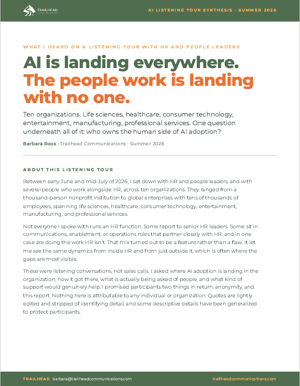
AI is landing everywhere. The people work is landing with no one.
You own the AI rollout. This summer I asked HR, people, and enablement leaders across ten organizations what it looks like from their side: where adoption is landing, where it’s stalling, and why.
The report covers eight findings, with anonymized stories and quotes, plus six concrete moves for the leader who owns the rollout.
You'll get the report by email, nothing else unless you ask for it.
What's inside
The answers were candid, sometimes uncomfortable, and remarkably consistent. Technology budgets are funded while adoption belongs to no one. Managers decide whether tools get used, and almost no one measures them separately. And two years into heavy AI spending, the CEO has started asking the ROI question.
The ownership vacuum
Technology teams become the default owner of adoption because they hold the purchase order. What the organizations that solved it did differently.
The manager multiplier
The single strongest finding of the tour: team adoption tracks manager adoption almost one to one.
Why training completion is the wrong metric
In the one organization that measured it, finishing the training didn’t predict usage. What did.
Policy without practice
Why a policy nobody has seen is worse than none, and where shadow AI goes as a result.
The fear no one is naming
How silence about jobs undermines a rollout, and what the organization furthest along says instead.
The money trail
Two years in, CEOs are asking what the investment returns. How to answer with a KPI at every stage.
Get the Report
Written to be shared
The report is authored by Barbara Roos, founder of Trailhead Communications, which helps IT and AI transformation leaders get the people side of their AI rollouts right. If the findings resonate, pass them along to your HR or people partner. They’re likely seeing the same thing.
Usage flat? Look at your managers first.
The Manager Adoption Diagnostic shows where your manager layer stands, what’s blocking it, and what to do in the next 90 days.